
Imagine you want to move from a custodial wallet to margin or futures trading on OKX while sitting in a small apartment in New York. You’ve heard “it’s anonymous” or “futures are a quick way to get rich,” and you’re nervous about KYC, leverage, and whether the exchange actually holds your coins. That concrete decision—can I safely, legally, and effectively trade on OKX from the US?—is the practical hinge for many readers. This article takes that practical scenario apart: how account login and verification work, what OKX futures truly offer, and which common assumptions about security and access are misleading.
We’ll correct myths with mechanism-level explanations, compare trade-offs you will face as a US-based trader, and leave you with a short, reusable decision framework: when to use spot, when to dip into margin, and when futures make sense given verification and regulatory constraints.
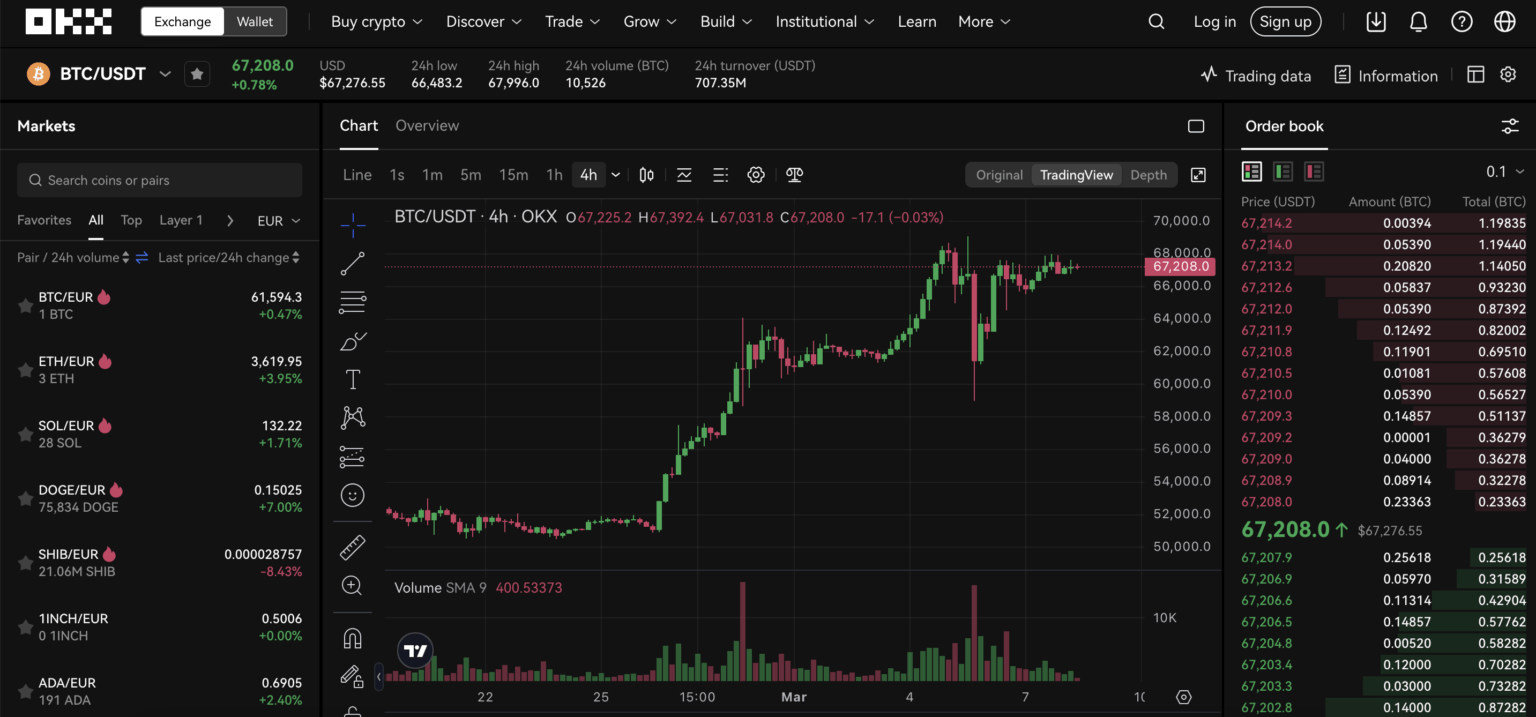
Myth 1 — “Login equals control”: what authentication actually protects and what it doesn’t
Reality: logging in is the gate, not the vault. OKX secures accounts with strong encryption, AI-driven threat detection, and mandatory two-factor authentication (SMS, Google Authenticator, or biometrics). That infrastructure reduces remote-account-takeover risk but does not remove other vector risks. Phishing, compromised email accounts, and social-engineering attacks remain the most common ways users lose access. Mechanism-wise: two-factor authentication adds an independent secret channel, but if that channel is intercepted or the device itself is compromised, the protection weakens.
Decision implication: treat the login as one layer in a defense-in-depth strategy. Use hardware keys where available, keep recovery email segregated from trading email, and prefer biometric login on mobile for convenience plus device-bound security. If you are linking a self-custodial Web3 wallet to the platform, remember that a compromised seed phrase bypasses exchange login protections altogether.
Myth 2 — “KYC is optional” and what OKX verification really entails
Reality: KYC is mandatory for account creation and expanded services. In practice this means submitting a government-issued ID and completing a facial-recognition liveness check. The mechanism is straightforward: ID documents are matched algorithmically to a live image to reduce identity fraud. The trade-off is that stronger verification unlocks more products (higher withdrawal limits, derivatives access, staking, and institutional features) but also creates regulatory and privacy exposure for users who prioritize anonymity.
For US-based traders this has practical consequences. Regulatory rules in the United States and the global AML regime make KYC unavoidable for serious trading volumes. If you want to use margin or futures—especially with high leverage—expect identity verification and sometimes additional proof of residence or source-of-funds checks. One clear boundary condition: limited functionality for unverified guests (viewing markets, small deposits or restricted withdrawals) versus full trading capability after completing KYC.
If you are ready to log in and verify, the platform’s account pages and mobile app are the pathway; for a quick start page and login guidance, see okx.
How OKX futures work — mechanism, risks, and realistic use-cases
At its core, OKX offers perpetual swaps, quarterly futures, and options with leverage ranging up to 125x for select assets. Mechanically, futures let you take a directional bet with borrowed capital. Cross-margin pools and isolated margin change the liquidation math: cross-margin reduces the chance of immediate liquidation by sharing collateral across positions but increases systemic risk to your account; isolated margin caps the downside to the isolated position but requires active risk management.
Important limitation: high leverage amplifies both gains and losses. Liquidations are not theoretical — they happen quickly in volatile crypto markets. Slippage and liquidity gaps matter: even if the contract supports 125x, low-liquidity assets will have wide bid-ask spreads and can produce cascade liquidations. Traders often underestimate funding-rate mechanics on perpetuals; the funding payments are the exchange’s method for pegging perpetual prices to spot and can be a persistent cost or credit depending on market sentiment.
Security and custody: what Proof-of-Reserves and cold storage mean for you
OKX reports storing over 95% of custodial assets in offline, air-gapped cold wallets using multi-signature approvals. Proof-of-Reserves improves transparency by allowing users to verify on-chain backing. Mechanistically this is distinct from formal insurance: on-chain proof shows assets exist at addresses, not that every future legal claim will be resolved favorably. The trade-off for traders: custody on a regulated exchange gives operational convenience (fast trading, staking, integrated DeFi access) at the cost of counterparty dependency. If you need absolute control, a non-custodial Web3 wallet—supported by OKX and compatible with Ledger/Trezor—keeps private keys in your hands but shifts the risk of permanent loss to you if the seed phrase is lost.
Decision heuristic: use custodial accounts for frequent trading and staking where convenience and speed matter; use non-custodial wallets for long-term holdings, DeFi interactions where you want sole custody, or when interacting with smart contracts you wish to control directly.
For more information, visit okx.
What the recent delisting of niche spot pairs tells you
OKX recently delisted several spot trading pairs (RSS3, MemeFi, GHST, RIO, and SWEAT). That routine housekeeping is instructive: exchanges periodically remove low-liquidity or compliance-risk listings to keep the order book healthy. Mechanism and implication: delisting reduces counterparty exposure to thin markets but also means traders holding niche tokens should be prepared for migration costs, impaired liquidity, and sometimes forced conversion windows. For US traders, a practical watch item is how often an exchange adjusts listings; frequent delistings on an asset you hold increases the operational risk of that asset on centralized platforms.
One decision-useful framework: when to trade what on OKX
– Spot: best for straightforward buying/selling, arbitrage-free holdings, and using PoR-backed custodial convenience. Minimal verification needed to start small, but higher levels unlock deposits/withdrawals and network access.
– Margin (up to 10x): appropriate when you understand collateral mechanics and can actively monitor positions. Prefer isolated margin for discrete experiments and cross-margin when you want to maintain broader collateral across an account.
– Futures and Options: suitable for hedging or precise directional bets when you have confirmed KYC and a risk plan. Use conservative leverage unless you employ automated risk controls (stop-loss, take-profit, position-sizing rules).
This framework prioritizes matching product complexity to verification status and risk tolerance; verification enables products but also increases regulatory traceability, which matters for serious traders in the US.
FAQ
Do I have to complete KYC to trade futures on OKX from the US?
Yes. Futures and large-margin products generally require full identity verification. KYC unlocks higher limits and derivatives access while also aligning the account with AML compliance. If you plan to trade derivatives at scale, budget time for document checks and potential follow-ups on source-of-funds.
Is my crypto safer on OKX than in my personal wallet?
It depends on the threat model. OKX stores most custodial assets in cold, multi-signature wallets and provides PoR transparency, which reduces exchange counterparty risk. However, custodial platforms create a single point of dependence: if the exchange is hacked or legally constrained, users may face delays or losses despite PoR. Non-custodial wallets transfer custody risk to the user (seed loss, malware). Choose custody based on trading frequency and your personal operational security capabilities.
What are the real costs when trading OKX futures beyond the obvious leverage?
Beyond margin interest and trading fees, consider funding rates on perpetuals (which can be persistent costs), slippage on large orders, and liquidation fees. Also factor in the operational cost of monitoring positions—higher leverage requires faster reaction times or automation.
How should a US trader respond to periodic delistings?
Track liquidity and listing notes for assets you hold. When a delisting is announced, evaluate converting to a more liquid asset, withdrawing to a self-custodial wallet, or using bridge mechanisms. Plan exit strategies in advance for low-volume tokens to avoid forced liquidation or rushed markets.
Closing practical note: the combination of mandatory KYC, layered login protections, custodial cold storage, and a full range of derivatives makes OKX a capable platform for US traders—provided you treat each product on its own terms. Learn the liquidation mechanics before you trade futures; pick an authentication scheme that matches your threat model; and accept that transparency (Proof-of-Reserves) improves trust but does not eliminate counterparty or regulatory risk. These are not abstract cautions—they are the operational trade-offs you will live with when you place the next order.